Ordering custom t-shirts sounds simple until you start making decisions. What blank? What weight? Where does the logo go? Screen print or something else? Plenty of people freeze at this point, pick whatever turns up first online, and end up with shirts that feel like sandpaper and a print that cracks after three washes.
It does not need to be complicated. Almost every good custom t-shirt order comes down to three decisions: the shirt itself, where the print goes, and how it is printed. Get those three right for what you actually need, and the rest sorts itself out.
Here is how to think through each one.
Start with what the shirts are actually for
Before you look at a single blank, be clear on the job the shirt is doing. This is the decision that quietly drives every other one.
A shirt handed out at a one-day event has different demands to a staff shirt worn four shifts a week. A club supporter tee that needs to look loud from across a field is a different brief to a fashion-leaning merch drop where the feel of the fabric is half the appeal. None of these is harder to make than the others. They just point you toward different blanks, placements and finishes.
So before anything else, answer this: who wears the shirt, how often, and what does it need to do? Promote something for a day? Survive commercial laundering? Look sharp in photos? Sell on a merch table? Once you know that, the other choices get much easier, because you are choosing for a purpose instead of guessing.
Choosing the blank without overcomplicating it
The blank is the shirt before we print on it, and it matters more than most people expect. Two shirts with the same logo, printed the same way, can feel completely different depending on what is underneath. There are really only three things to settle.
Fabric
For most custom t-shirt printing, the choice is between cotton, a cotton-poly blend, or a performance fabric.
- 100% cotton is soft, breathable and gives the cleanest print surface. It suits events, fashion-style tees and anything where comfort and a natural feel matter.
- Cotton-poly blends hold their shape, shrink less and handle repeated washing well. This is a sensible pick for staff shirts and uniforms that get washed constantly.
- Performance polyester wicks moisture and suits sports and active club gear. It needs a print method matched to synthetics, which is worth flagging early so the print bonds properly.
Weight
Fabric weight is measured in GSM (grams per square metre), and it is the simplest way to picture how a shirt will feel.
- Lightweight (around 120 to 150 GSM) is cooler and more drapey. Good for summer events and fashion fits, less hard-wearing.
- Midweight (around 160 to 185 GSM) is the all-rounder most custom work lands on. It feels substantial without being heavy and takes a print well.
- Heavyweight (around 200 GSM and up) feels premium and lasts. Worth it for staff shirts and anything that needs to survive heavy use.
Brand and fit
In New Zealand you will mostly see a few familiar names. AS Colour is the go-to for a retail, fashion-style fit and is popular for merch. Gildan and similar labels are dependable workhorses for larger promotional runs. Uniform and sportswear brands like Stencil and Biz Collection lean toward performance fabrics and structured fits.
Fit matters as much as brand. Most ranges cover regular, fitted, relaxed, women’s and youth cuts, usually from XS through to 5XL depending on the style and colour. If you are kitting out a mixed group, a relaxed unisex fit with a women’s option alongside it keeps everyone comfortable. Sort the fit and size spread early and the order runs smoothly.
You do not have to memorise any of this. Tell us the use case and we will point you at two or three blanks that fit, rather than handing you a catalogue.
Print position: where the design sits and why it matters
Placement changes how a shirt reads at a glance, so it is worth a moment’s thought rather than defaulting to “front, I guess.” These are the common positions and roughly how big each one tends to run.
- Left chest (around 8 to 10cm wide): the standard for logos on branded t-shirts and staff wear. Clean, professional, reads as a uniform rather than merch.
- Full front (around 25 to 30cm wide): bold and immediate. Suits event branding, promotional designs and anything that needs to be seen.
- Full back (around 28 to 36cm wide): the spot for team names, big graphics and sponsor panels. Pairs well with a left chest logo on the front.
- Sleeve (around 5 to 8cm): subtle. Good for a secondary logo, a sponsor, or a small detail that lifts the whole shirt.
- Nape (back neck): small and understated, often used for a brand mark on fashion-leaning tees.
The right choice follows the job. Staff and corporate shirts usually want a left chest logo, because it looks like a uniform and not a giveaway. Event and supporter shirts earn their keep with a full front or full back so the message carries. Club gear often combines positions: chest logo, big back graphic, sponsor on the sleeve. If you are running more than one position, it helps to plan them together so the colours and alignment match across the shirt.
Finish: how the print actually looks and feels
“Finish” covers both the method and the result. The same artwork can sit on a shirt three different ways depending on how it is printed, and each has a look and feel of its own.
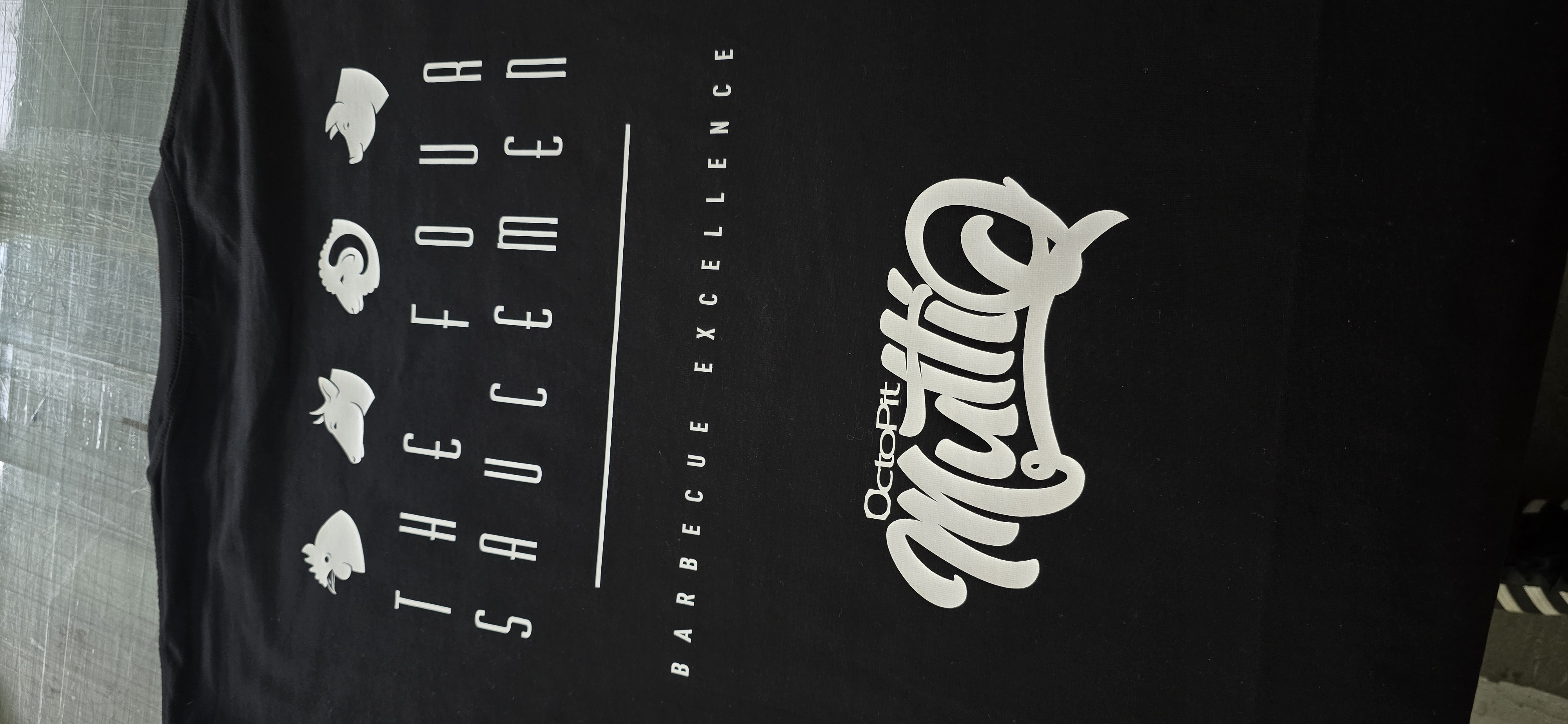
- Screen printing pushes ink through a mesh screen so it bonds into the fabric. The result is vivid and hard-wearing, and on cotton it almost becomes part of the shirt. It is the standard for bold designs with solid colours, and it gets more efficient the larger the run, since each colour needs its own screen.
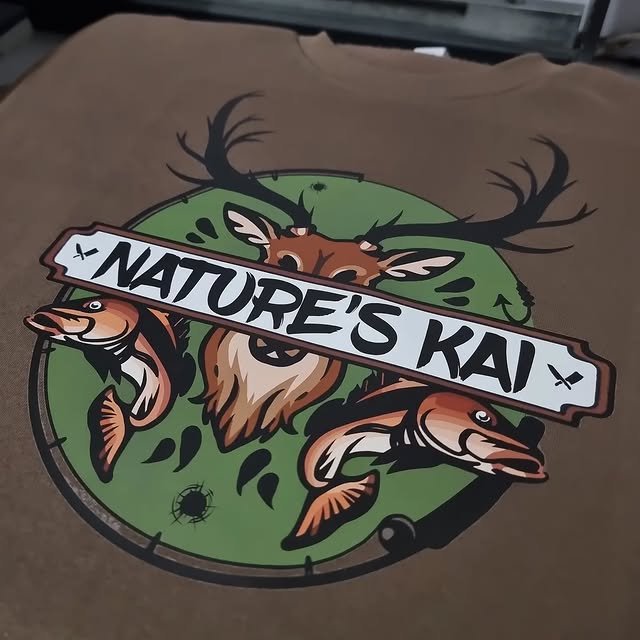
- Heat transfer and DTF print the design and apply it with heat, so it sits on top of the fabric. This is the one for full-colour artwork, photographic images and fine detail, and it works well on smaller runs and for personalised names and numbers.
- Embroidery stitches the design into the fabric for a raised, textured, premium finish. Best for logos on polos and heavier garments. It is not the right call for large or highly detailed artwork, where the stitch count gets unwieldy.
Two more things shape the result. Printing on dark shirts usually needs a white underbase layer first, so the colours stay bright instead of sinking into the fabric. And the artwork itself steers the method: a simple two-colour logo is perfect for screen printing, while a detailed full-colour illustration is better suited to transfer. There is no single best finish, only the one that suits your design, your shirt and how the shirt will be used.
Artwork: what helps before we print
Your artwork decides what is achievable, so it is worth getting in good shape before production. A clean vector file opens up every method. A small image pulled off a social media page limits your options.
A vector logo (AI, EPS, SVG or a vector PDF) is ideal, because it scales to any size without going fuzzy. A high-resolution PNG or TIFF works for most jobs as long as it is large enough for the print size you want. The thing that catches people out is a low-resolution image, often a logo built for a website header at a couple of hundred pixels wide. It looks fine on screen and falls apart the moment you blow it up to a full-back print.
If your file is not print-ready, that is not a problem. Our graphic design team can redraw or clean up a logo so it prints sharp, and you end up with a proper file you can reuse for future orders. Flagging this early is far better than discovering it at the press.
Why local Auckland advice beats ordering blind
You can order printed t-shirts online from anywhere. What you cannot do online is feel the blank before you commit, see how a colour actually prints, or have someone tell you that the placement you picked will look off on a women’s fit.
That is the case for using a local team. We are based in Henderson, West Auckland, and we work with businesses, clubs, schools and event organisers right across Auckland. You can talk through the options with a person who has printed thousands of these, check a sample, and make the call with real information instead of a thumbnail and a guess. For logo t-shirts and staff gear especially, that bit of back-and-forth is the difference between shirts that get worn and shirts that sit in a box.
It also means if you are ordering across a few items, say tees plus custom hoodies or workwear, we can keep the branding consistent across the lot rather than having it drift between suppliers.
Tell us what the shirts are for
The fastest way to a useful quote on custom t-shirts in Auckland is to tell us the basics:
- What the shirts are for (staff, event, club, merch, fundraiser)
- Rough numbers and a size spread if you have one
- Your artwork (vector if you have it, an image if not)
- Where you want the print (chest, front, back, sleeve, or unsure)
- Any preference on the shirt itself, or just tell us the use case and we will recommend
You do not need all of it locked in. If you know you want 40 club tees with a logo and have not settled on the blank, that is plenty to start the conversation.
We will come back with a recommendation that suits the job, not a generic line-up. Get in touch for a quote or take a look at our t-shirt printing service page for more on how we work.